Experience in Designing and Installing Ducted Fresh Air Systems, with Actual Measurement Results
I previously installed a ducted fresh air system during home renovation. Being idle during the pandemic, I measured the air velocity at home and wrote a summary along with key considerations for design.
In short, you must calculate the air velocity and air volume yourself, then specify the requirements. Otherwise, the installed system will likely not meet the standards.
Issues with Ducted Fresh Air Systems
The primary issue is the trade-off between noise and ventilation capacity. The noise from the machine’s motor and the sound at the vents can be very loud. If installed carelessly, there’s a high probability you won’t want to turn it on due to the noise. If it’s not running 24/7, can it even be called a fresh air system?
Vent noise is directly related to air velocity, which in turn is related to ventilation capacity. This requires weighing the pros and cons, something manufacturers’ designers often don’t consider.
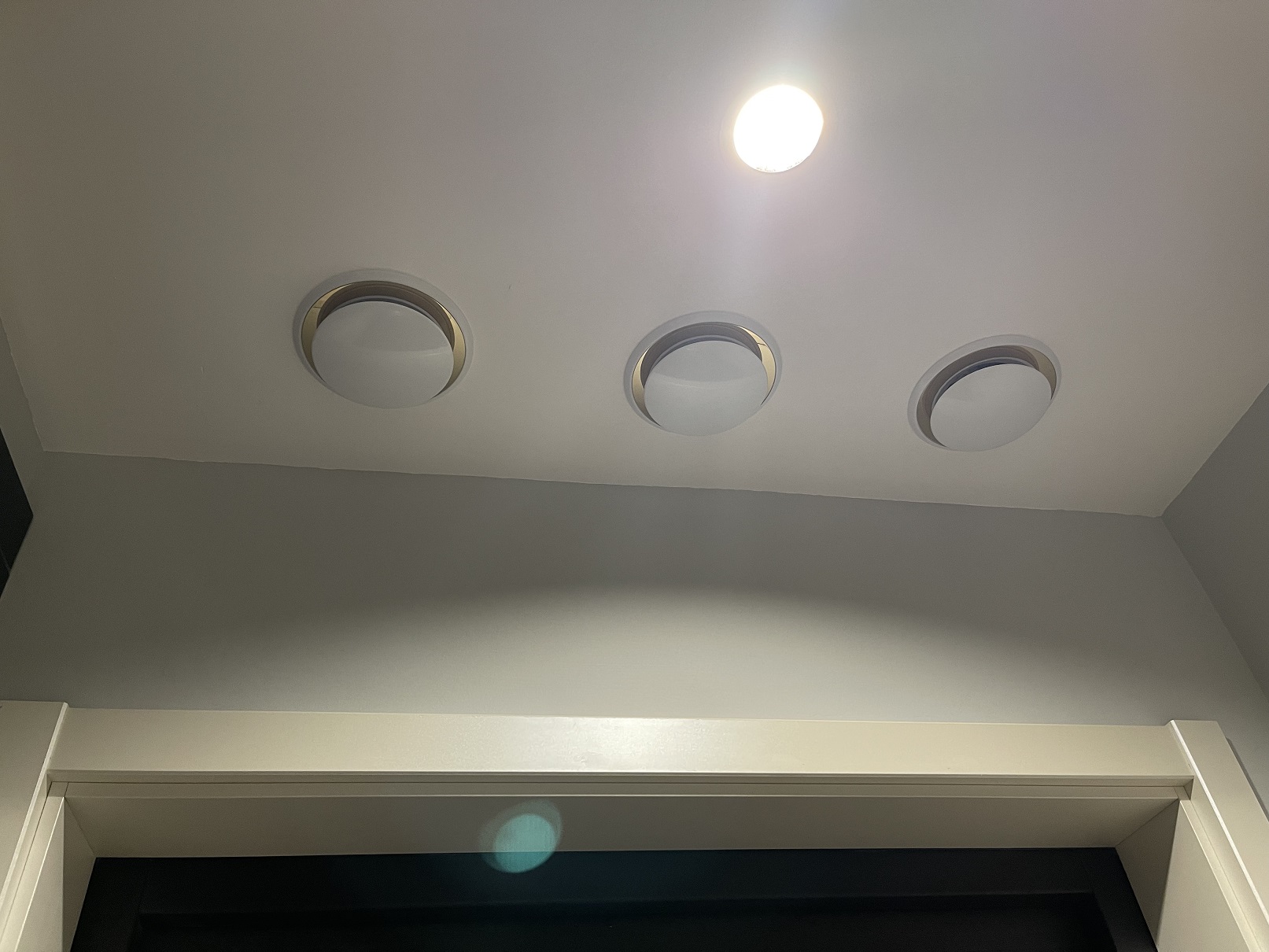
Calculation Method
Here are our basic goals: Air Changes per Hour: 0.8 times (National Standard). Ideally double that, above 1.6 times, so you can run it at half speed daily, meeting the standard with lower noise. Maximum Air Velocity at Vents: 3.5 m/s (National Standard). Target 2.5 m/s.
These are the duct constants: Note: Nowadays, fresh air systems use PE ducts. PVC ducts are no longer considered. PE Diameter (mm): 75 PE Inner Diameter (mm): 63 PE Cross-sectional Area (m²): 0.003117 PE Unit Airflow (m³/h): 11.22208
Then calculate the following data for each room: Area (m²): Input Ceiling Height (m): Input Volume (m³): = Area * Ceiling Height Target Air Change Volume (m³/h): = Volume * Air Changes per Hour Required Supply Vents: = Target Air Change Volume / PE Unit Airflow / Maximum Air Velocity at Vents
The above calculates the number of supply vents needed for each room. The number of return vents can simply be one less than the number of supply vents, but there must be at least one.
My target parameters:
| Bedroom | Living Room | |
|---|---|---|
| Air Changes times/h |
2 | 1.8 |
| Noise-limited Velocity m/s |
2 | 3.5 |
| PE Diameter mm |
75 | 75 |
| PE Inner Diameter mm |
63 | 63 |
| PE Cross-sectional Area m² |
0.00312 | 0.00312 |
| PE Unit Airflow m³/h |
11.2221 | 11.2221 |
| Area m² |
10 | 35 |
| Ceiling Height m |
2.7 | 2.7 |
| Volume m³ |
27 | 94.5 |
| Required Air Change Volume m³/h |
54 | 170.1 |
| Required Supply Vents units |
2.41 | 4.33 |
Fresh air units have a basic performance indicator: air change volume. Summing the Target Air Change Volume for all rooms gives the required performance of the fresh air unit. The table above requires a unit with a capacity of at least 54+170=224 m³/h, meaning a 250 model is needed.
Calculation Results
Be mindful of controlling desires because more vents make installation harder, and exceeding 10 vents requires a special unit model. So, set the Air Changes per Hour lower, or increase the Maximum Air Velocity, or omit some rooms.
Current fresh air designs often just assign one supply vent per room. Looking at the above results, it’s clear this is completely unreasonable. However, even if you specify requirements, the designer may not necessarily understand them.
Choosing a Fresh Air Unit
The effectiveness of a ducted fresh air system relies mainly on design and installation. The unit itself is less critical; it’s essentially two blowers plus a HEPA filter and a paper core. There’s no high technology involved, so there’s no need to pursue imported brands—just choose a suitable one. If you’re concerned about heat exchange performance, consider giving it up. I’ve heard most brands perform poorly in actual tests. Its performance is proportional to the machine’s size, and current models are mostly small.
Installation Challenges
Outdoor exhaust and intake vents must be far apart, at least 1 meter, to prevent short-circuiting. The intake vent location should avoid odors, cooking fumes, and neighbors’ balconies (where people might smoke). Keep it away from your own and surrounding water heater exhaust vents, especially those downstairs. These requirements are the hardest to meet.
With so many vents, a larger air distribution box is necessary; choose one with sound-absorbing material. PE ducts should be as short as possible, with fewer bends and fewer beams to cross. Supply vents should be placed near windows or the entrance door. Return vents in these areas can create low pressure, drawing in outdoor dust.
After installation, measure the air velocity at each vent. They will generally differ. Adjust the dampers on the distribution box to make the velocities as close as possible. Since adjustments affect each other, it’s tricky. If the differences aren’t too large, it’s okay not to adjust.
Overthinking can cause anxiety. Basically, meeting the above requirements already surpasses 99% of installations, which is good enough.
I once fantasized that if the supply vent blew towards the outdoor unit of the air conditioner, it could improve heat exchange efficiency. In winter, the exhausted indoor warm air could help defrost the AC’s radiator; in summer, the cool air could help cool the outdoor unit’s radiator. Sounds perfect.
Cost
I used a total of 75 meters of PE ducting, with 6 supply vents and 4 return vents. PE duct costs 10 yuan per meter, vents and terminals cost 40 yuan each. I bought these myself for about 1200 yuan. The distribution box and other materials were provided by the installation team, with the total installation cost being 4000 yuan.
Post-Installation Results
How much do the actual results differ from my initial design? I measured the air velocity at the vents with an anemometer:
| Full Speed | Bedroom | Living Room |
|---|---|---|
| Supply Vents units |
2 | 4 |
| Measured Avg. Velocity m/s |
2.45 | 3.25 |
| Converted Air Change Volume m³/h |
55 | 145 |
| Converted Air Changes times/h |
2.35 | 1.65 |
The above data is at the highest speed, very close to the design. Due to duct resistance, the total airflow from the vents is only about 200 m³/h. The bedroom has higher velocity (I was too lazy to adjust the damper). The living room velocity is lower due to longer duct runs. The noise level is similar to central air conditioning noise, which is unacceptable, so I only run it at half speed maximum.
For sleeping, I usually run it at 1/3 speed. At this setting, it’s completely silent, and the effect is quite good. Data as follows:
| 1/3 Speed | Bedroom | Living Room |
|---|---|---|
| Supply Vents units |
2 | 4 |
| Measured Avg. Velocity m/s |
1.15 | 1.41 |
| Converted Air Change Volume m³/h |
26 | 63 |
| Converted Air Changes times/h |
1.1 | 0.72 |
This setting also meets the national standard and is completely silent. The total vent airflow is 89 m³/h, which is also close to 250 multiplied by 1/3.
CO₂ Test
Tested with one person and one cat. With windows closed for 8 hours, CO₂ rises to around 1500 ppm. Running the fresh air system at 1/3 speed maintains it around 800 ppm. At full speed, it’s maintained around 600 ppm. I originally thought 2 air changes per hour would comfortably maintain CO₂ at 400 ppm. The ideal is good, but 800 is already quite good.
Airtightness
Because I installed a fresh air system, I focused on improving the house’s airtightness. The doors and windows already have high airtightness. For other areas like drains, range hood, and water heater exhaust pipes, I installed check valves with gaskets. Being an amateur, this caused a problem: with almost no air exchange, subtle pressure changes cause air (and dust) to be drawn in through the conduits for the main electrical panel’s incoming wires. Sometimes I can even smell cigarette smoke from the neighbors, which is absurd. Even more absurdly, excessive negative pressure can cause backflow in drains because air can only be drawn in through the drain pipes.
Now I maintain positive pressure in the room by setting Intake Speed > Exhaust Speed. However, occasionally when the gas water heater starts or the bathroom exhaust fan runs, it still becomes negative pressure.
It seems like something like a vent to the outdoors is needed—a valve that opens to release pressure when it reaches a certain level. Shopping malls use something called an excess pressure valve, but I haven’t seen one for home use. I never thought a home would need such a thing…

1700515